Someone on your team needs to write an email, summarize a long document, review a spreadsheet, or prepare notes for a meeting. Instead of spending an hour on it, they open an AI tool and finish the task in minutes.
From the employee's point of view, it is simply a faster way to work. But there is another question business owners need to consider: What information did that employee give the AI tool, and who or what now has access to it?
For small and midsize businesses in Wilmington, NC, AI security does not have to become a complicated technology project. The most important first steps are much more practical. Know which AI tools employees are using, decide what information those tools can access, control who has permission to use sensitive data, and create clear rules employees can follow.
Recent cybersecurity research is making one point especially clear: companies are adopting AI faster than many of them are learning how to manage it safely.
The AI Security Problem Is Often an Access Problem
When people think about AI security, they may picture someone attacking an AI system with advanced hacking tools. That can happen, but many of the risks begin somewhere much more familiar: user accounts and permissions.
A March 2026 Cybersecurity Dive report described identity as a major part of today's cybersecurity problem. Attackers increasingly try to use stolen passwords, login sessions, and trusted accounts because logging in as a real user can be easier than trying to break through a company's defenses. AI can make that problem worse by helping criminals create more convincing impersonation and social engineering attempts.
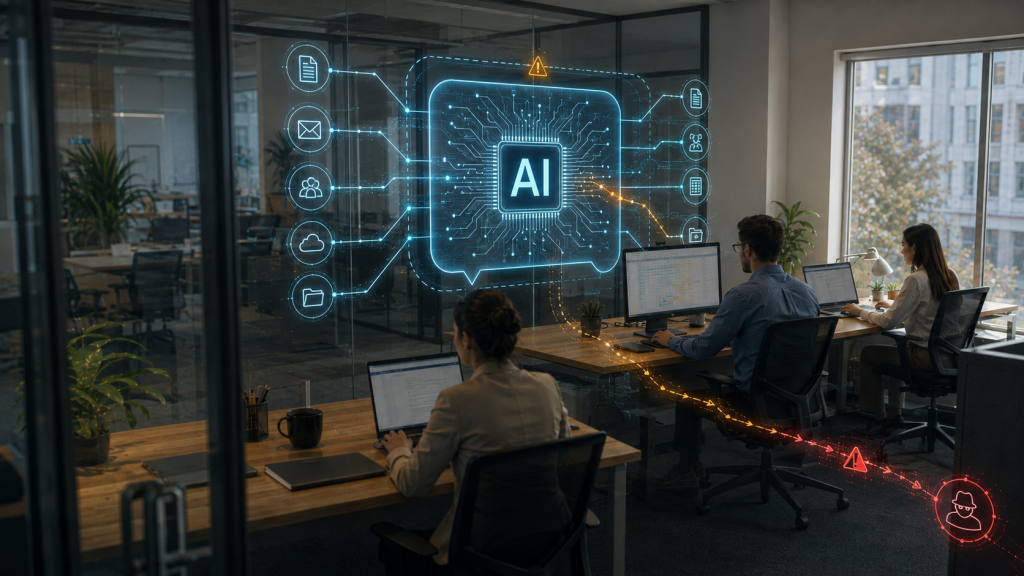
AI also creates new types of accounts inside a business. An AI agent may be allowed to read files, work with company data, connect to software, or complete tasks for an employee. That means businesses now have to think about access for people and for software acting on behalf of people.
This matters because access tends to grow quietly.
An employee needs permission to complete a project. A new application gets connected to Microsoft 365. An AI tool receives access to a shared folder. Months later, nobody remembers exactly why the access was granted or whether it is still needed.
The danger is not always a bad decision. Sometimes it is simply a collection of small decisions that nobody reviews.
AI Is Creating More Accounts and More Places to Lose Track of Access
Research from identity security company Netwrix shows how quickly this problem can grow. According to a June 2026 Cybersecurity Dive report, about three-quarters of surveyed organizations did not have a complete view of their sensitive data and the identities that could access it. Seventy-one percent could not quickly determine which identities had access to which data.
That becomes important when AI tools begin working with information that employees already use every day.
A Wilmington law firm may have client records and confidential documents. A dental practice may have patient information. A CPA firm may work with tax records and financial data. A real estate company may handle contracts, identification documents, and information related to closings.
An employee may be using AI for a perfectly reasonable business purpose. The question is whether the company understands what data is being shared and whether the AI tool has more access than it needs.
Netwrix also found that companies with widespread AI use reported a higher rate of data breaches than companies not using AI, 43% compared with 11% during the prior 12 months. That does not mean AI alone caused those breaches. It does show why companies need to pay attention as AI becomes more deeply connected to everyday work.
Shadow AI May Be the Risk Business Owners Never See
One of the hardest problems to manage is sometimes called "shadow AI."
Shadow AI simply means employees are using AI tools that the business has not approved or does not know about.
Think about how easily this can happen. An employee discovers an AI website that saves time. They create an account using their work email address and begin using it to summarize documents or answer questions. Because the tool is useful, they tell a coworker.
Soon, several employees are using it.
Nobody was trying to ignore company security. They were trying to get more work done.
That is what makes shadow AI different from many traditional cybersecurity problems. Productivity can actually hide the risk. When a tool makes employees faster, there may be little reason for them to report it or ask whether the business has approved it.
IBM's 2026 Cost of a Data Breach Report found that the share of security incidents involving shadow AI more than doubled from the previous year to 43%. More than two-thirds of organizations in the study did not have processes in place to control shadow AI.
Research reported by Cybersecurity Dive in June also found that security leaders were concerned about the same lack of visibility. When IT teams do not know which AI systems employees are using, it becomes much harder to protect company information or understand where that information is going.
The Cost of Getting AI Security Wrong Is Growing
AI is not creating an entirely new cybersecurity world. It is adding another layer to problems businesses already have.
According to IBM's 2026 research, the average data breach reached about $5 million, up 12% from the previous year's report. Attacks involving certain AI systems could be even more expensive. IBM also found that 92% of organizations that experienced attacks against their AI models had failed to properly control access to those systems. Only four in ten organizations said they limited access to their AI systems.
Those are large-company averages and should not be treated as the expected cost of a breach for a small Wilmington business. But the lesson still matters.
A smaller business may not experience a multimillion-dollar event, but it also may have fewer people and fewer financial resources available to recover. An incident can interrupt appointments, delay client work, stop employees from accessing files, create unexpected expenses, and take leadership away from running the business.
That is why AI security should be viewed as a business operations issue, not simply an IT issue.
AI Does Not Make the Cybersecurity Basics Less Important
One of the most useful findings in the recent research is also one of the simplest: companies still need to do the basics well.
AI may be new, but criminals still look for weak passwords, stolen accounts, poorly managed permissions, unprotected data, and employees who can be tricked into giving away information.
Before adding complicated AI security controls, small businesses should make sure the foundation is strong. That includes:
- Know which AI tools employees are using and create a short list of approved tools.
- Decide what types of company, client, patient, or financial information should never be entered into public AI systems.
- Require Multi-Factor Authentication and use password management tools that make secure logins easier for employees.
- Remove access when employees leave and review whether current employees still need all of the permissions they have.
- Protect computers with endpoint detection and response that watches for suspicious activity.
- Give employees practical cybersecurity training that helps them recognize threats during a normal workday.
- Protect sensitive information with computer and server encryption that helps keep business data private.
None of these steps requires employees to stop using AI. The goal is to make useful technology easier to use safely.
Give Employees Rules They Can Actually Follow
A 30-page AI policy will not help much if nobody reads it.
Small businesses often do better by starting with a few clear questions employees can remember before using an AI tool:
Is this an approved tool? Am I about to enter private company or customer information? Does this tool really need access to this file or account? Would I be comfortable telling my manager what information I shared?
Employees are much more likely to follow security rules when those rules make sense in the middle of a busy workday.
That is especially important because AI use can spread faster than traditional business software. A company might spend weeks choosing a new accounting system or practice management platform, while an employee can begin using a new AI service during lunch.
Leadership needs a way to make good decisions at roughly the same speed employees are discovering new tools.
AI Governance Does Not Have to Mean More Red Tape
The word "governance" can make AI security sound much more complicated than it needs to be.
For a small or midsize business, AI governance simply means deciding how AI should be used, which tools are acceptable, what information needs protection, and who is responsible for making those decisions.
The companies in Jamf's 2026 research that were using AI more deeply also reported higher rates of AI-related security incidents. Among organizations exploring AI, the incident rate was below 20%. Among those that had deeply built AI into their workflows, the rate reached 27%.
Again, that does not prove AI caused every incident. What it does show is that security needs to grow along with AI use.
A business should not wait until AI is connected to dozens of employees, applications, and data sources before deciding how it will be managed.
The Goal Is Safe Productivity, Not Less AI
AI can be valuable for Wilmington businesses. It can help employees save time, organize information, draft content, research ideas, and handle repetitive work.
The goal should not be to make employees afraid to use it.
The better approach is to give people a safe path forward. Employees should know which tools they can use, what information they can share, and where to ask questions when they are unsure. Leadership should know which AI services are connected to company systems and whether those services have more access than they need.
That balance matters because businesses rarely lose control of technology all at once. It happens one convenient decision at a time.
AI is becoming another normal part of the workday. The businesses that manage it well will be the ones that treat security as part of adopting the technology, rather than something to add later.
If you are not sure what AI tools are already connected to your business or where your biggest technology risks may be hiding, Earney IT can help. We can review your technology risk score in 15 minutes or less and help you identify practical next steps for keeping your Wilmington business productive and protected.